

Swebsy vs Carrd: pricing, pages and export compared
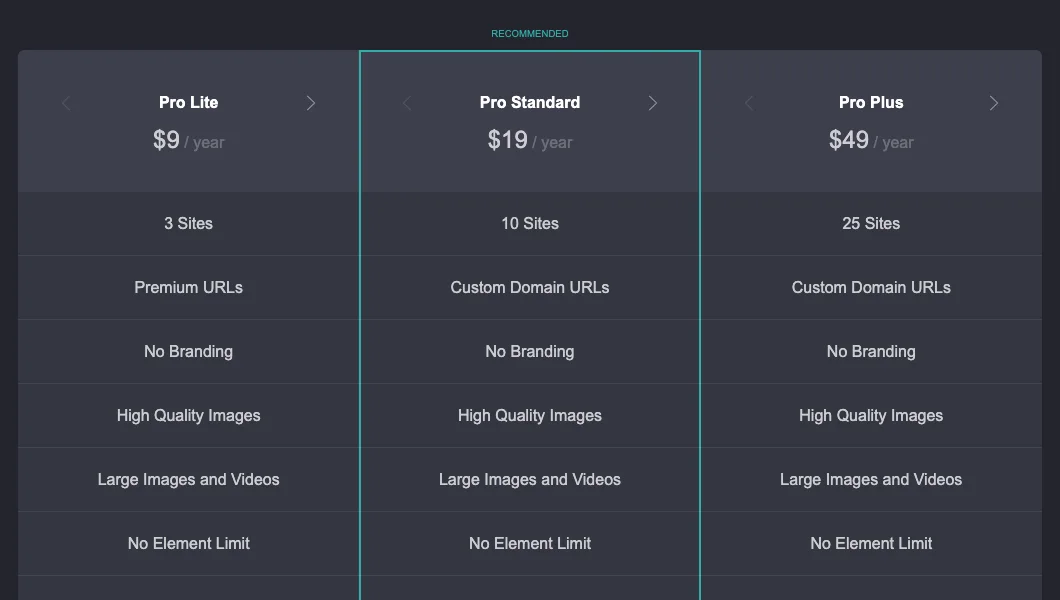
Pick Carrd for a single page: a profile, a link-in-bio, a simple landing page. It’s fast to learn, and $19 a year for a custom domain and forms is hard to beat.
Pick Swebsy once one page stops being enough: separate pages with their own URLs, a design system you control, or the full site as files you can host anywhere, for free.
We make Swebsy, so weigh that. Every Carrd fact below links to Carrd’s own pricing page or docs. Prices are in USD, checked on 25 September 2026.
At a glance
Section titled “At a glance”| Carrd | Swebsy | |
|---|---|---|
| Best for | One-page sites | Small multi-page sites |
| Site structure | One page. Sections fake extra “pages” | Real pages, each its own HTML file |
| Free plan | 3 sites on a carrd.co address, with Carrd branding | Whole editor, unlimited local projects, no account |
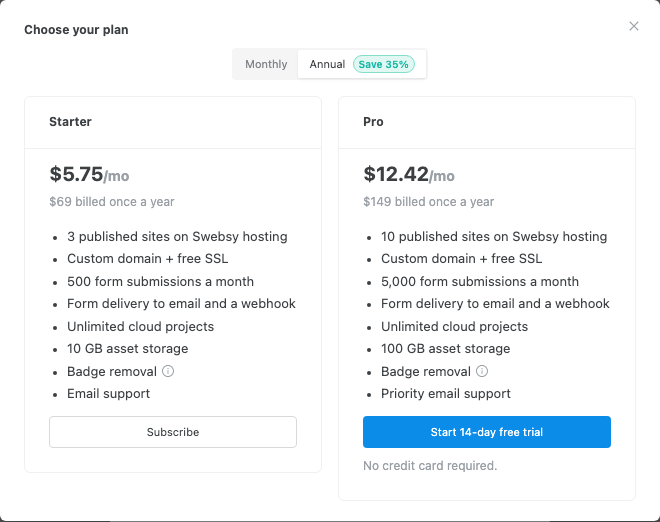
| Custom domain | From $19/year (Pro Standard) | Free on GitHub or Cloudflare Pages. From $69/year on our host |
| Forms | From $19/year, sent to your email or mailing tool | From $69/year on Swebsy Hosting, or free with your own form service |
| Download the site’s code | Pro Plus, $49/year. Forms stop working in the download | Free, on every plan |
| Remove the builder’s badge | From $9/year | From $69/year. Free exports keep a small Swebsy badge |
| AI editing | None listed on its plans | AI builder with your own model key, plus an MCP bridge for coding agents |
| Keep editing a download | No. It can’t go back into Carrd | Yes, with the editable project backup |
Pricing, side by side
Section titled “Pricing, side by side”Carrd is paid yearly and priced like a utility. Here are its three Pro tiers:
Swebsy’s free plan is the whole editor, with no time limit. The paid plans add hosting on our servers, cloud sync, hosted forms and badge removal:
What that means for a few common jobs:
| The job | Carrd | Swebsy |
|---|---|---|
| One page on your own domain, with a contact form | $19/year | $0 on Cloudflare or GitHub Pages plus an outside form service, or $69/year hosted |
| The same, without the builder’s badge | $19/year | $69/year |
| A 4-page site on your own domain | Not possible as real pages | $0 self-hosted, or $69/year hosted |
| Download the site’s code | $49/year | $0 |
| 10 sites with forms | $19/year | $149/year |
For small hosted sites, Carrd is cheaper, and we won’t pretend otherwise. Swebsy costs less when you host the files yourself, or when you need real pages or the code.
The editors
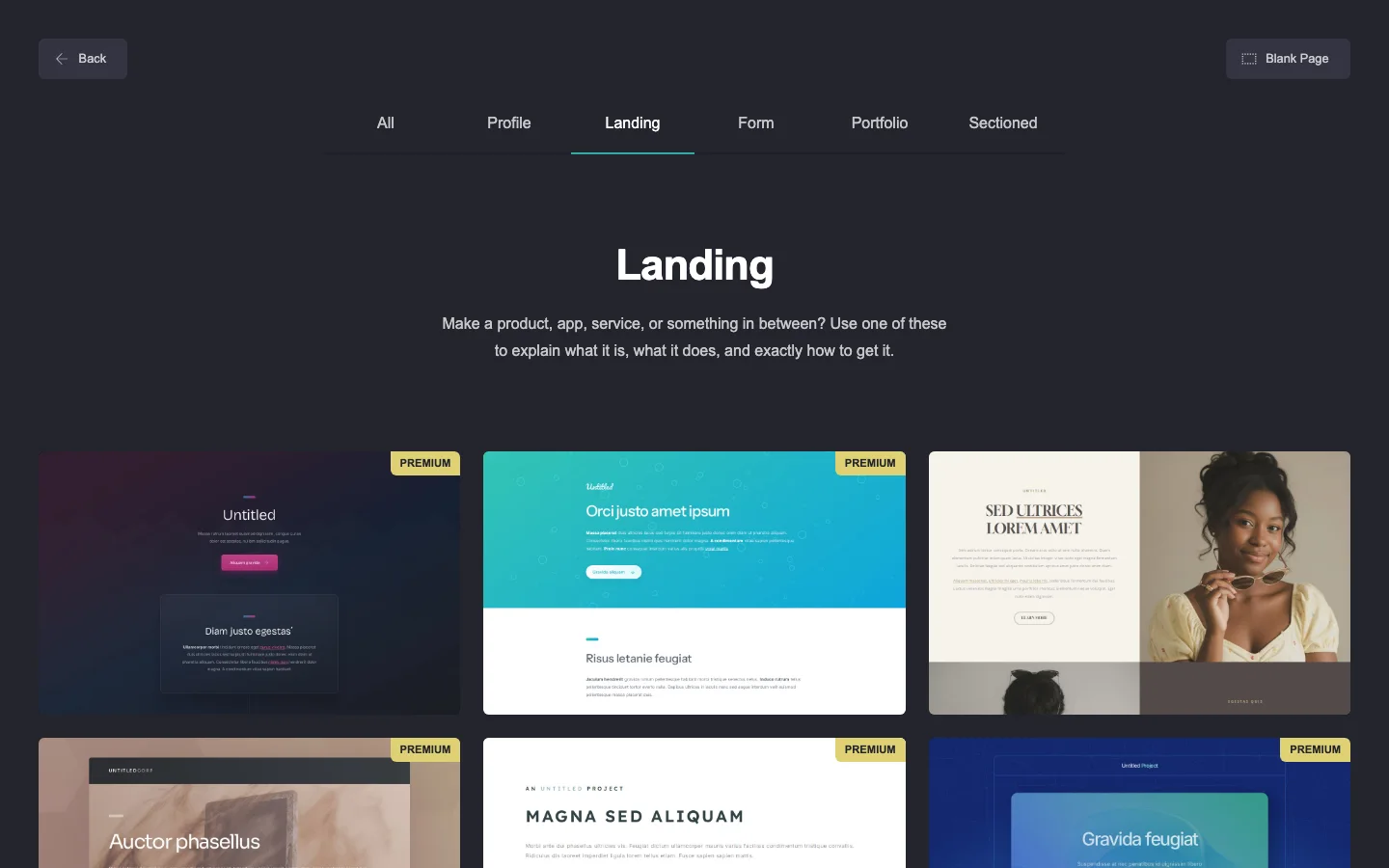
Section titled “The editors”Carrd starts you on a template picker. Every template is one page, split into sections, and you edit elements directly on it.
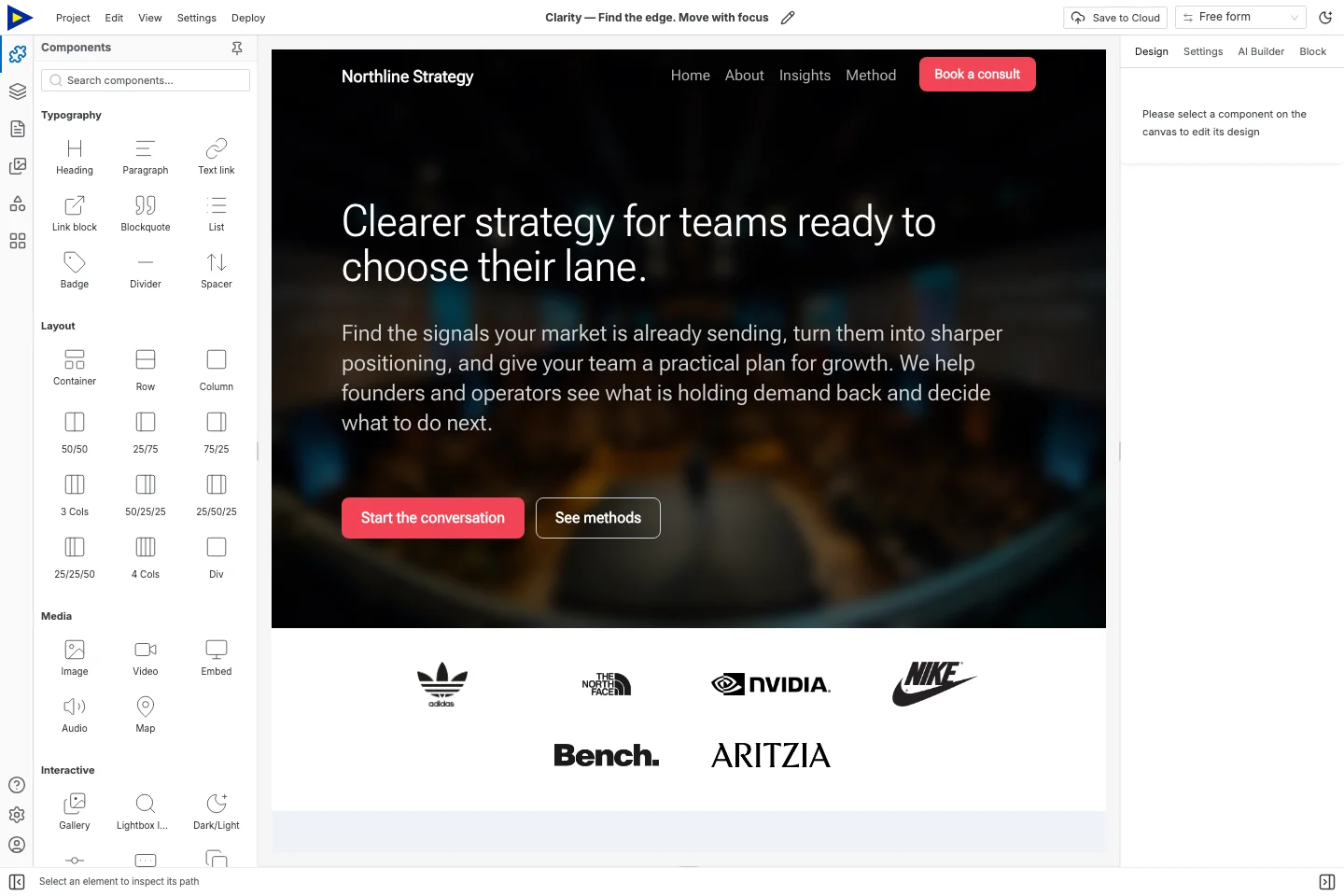
Swebsy’s Studio is a full visual editor: layers, a design panel, theme tokens, responsive views, and a page list on the left.
Carrd has fewer controls, and that’s on purpose. If you want to get a page up in an evening and never touch a style panel, that’s a real advantage. Swebsy gives you more control, and there’s more to learn.
One page or several?
Section titled “One page or several?”This is the biggest difference, so decide it first.
Carrd’s sections let you “simulate the effect of having multiple pages on a one-page site”. Visitors can jump between views, but it’s still one page underneath. A profile with a short bio, a few links and a contact button fits that nicely.
A consultant with services, case studies and an about page usually wants real pages. Each one gets its own address, title and description, which is easier to share, link to and maintain. In Swebsy every page exports as its own HTML file.
Don’t pick based on SEO myths. Neither structure ranks you by itself. Useful content and working links matter far more.
Owning your site
Section titled “Owning your site”“Can I take my site with me?” means two things: the files visitors load, and a project you can keep editing.
Carrd. Downloading your site needs Pro Plus or higher. Forms stay visible but stop working in the download, and the downloaded copy can’t be uploaded back into Carrd. It’s a snapshot, not a way to move your editing somewhere else.
Swebsy. Deploy → Export code gives you the website ZIP on any plan. Project → Export Project gives you an editable backup you can import again later. You get both, and neither needs an account.
Where Carrd is the better choice
Section titled “Where Carrd is the better choice”- Your site is one page and will stay that way.
- You want the lowest possible yearly price for a hosted site on your own domain.
- You want forms that connect straight to mailing tools like Mailchimp or Kit.
- You’d rather have fewer options than learn a full design panel.
Where Swebsy is the better choice
Section titled “Where Swebsy is the better choice”- You need real pages: services, case studies, a separate contact page.
- You want the site’s code, for free, and a project you can keep editing.
- You host on GitHub Pages or Cloudflare Pages already.
- You want to use an AI builder or a coding agent to draft and edit pages.
Moving from Carrd to Swebsy
Section titled “Moving from Carrd to Swebsy”There’s no importer. You rebuild the page in Swebsy, usually starting from a template, then reconnect your form and domain.
If your Carrd site does its job and updating it feels easy, stay. Switch when you can name what’s missing. Then try the multi-page export guide with your real content before you move the domain.